


Roast Leg of Lamb
This roast leg of lamb cooks in one large pot with potatoes, green beans, red onion and a whole bulb of garlic tucked underneath it, so while the lamb slowly roasts, all those beautiful juices drip down into the vegetables below.
The lamb is coated in a thick garlic, lemon, mustard and herb marinade made with fresh thyme, oregano, bay leaf and plenty of garlic, then cooked gently with white wine or stock until tender.
For the final 20 to 30 minutes, the lid comes off so the lamb can develop that gorgeous golden exterior.
By the time it reaches the table, you have tender roast lamb, potatoes, vegetables, soft roasted garlic and rich pan juices all from the same pot.
One pot to wash.
And the pestle and mortar. 😂
Why You’ll Love This Roast Leg of Lamb
- The lamb, potatoes and vegetables all cook together.
- The garlic, lemon, mustard and herbs give the lamb loads of flavour.
- Cooking it covered for most of the time keeps the pot moist.
- The potatoes absorb the lamb juices as they roast.
- The whole garlic bulb becomes soft, sweet and almost creamy.
- You can use white wine or stock.
- Most of the cooking happens without you standing at the stove.
- It works beautifully for Sunday lunch, Easter, entertaining or Christmas.
And because the sides are already cooking underneath the lamb, you are not trying to coordinate three different trays at the same time. have you tried my AIRFRYER ROAST LAMB recipe yet? Click here for the recipe
A One-Pot Roast Lamb Dinner
I love a proper roast, but I do not love the mountain of dishes that can come with one.
A roasting tray for the lamb.
Another for potatoes.
A saucepan for the vegetables.
Something else for gravy.
By the time lunch is finished, the kitchen looks like it hosted the event rather than you.
This recipe is different.
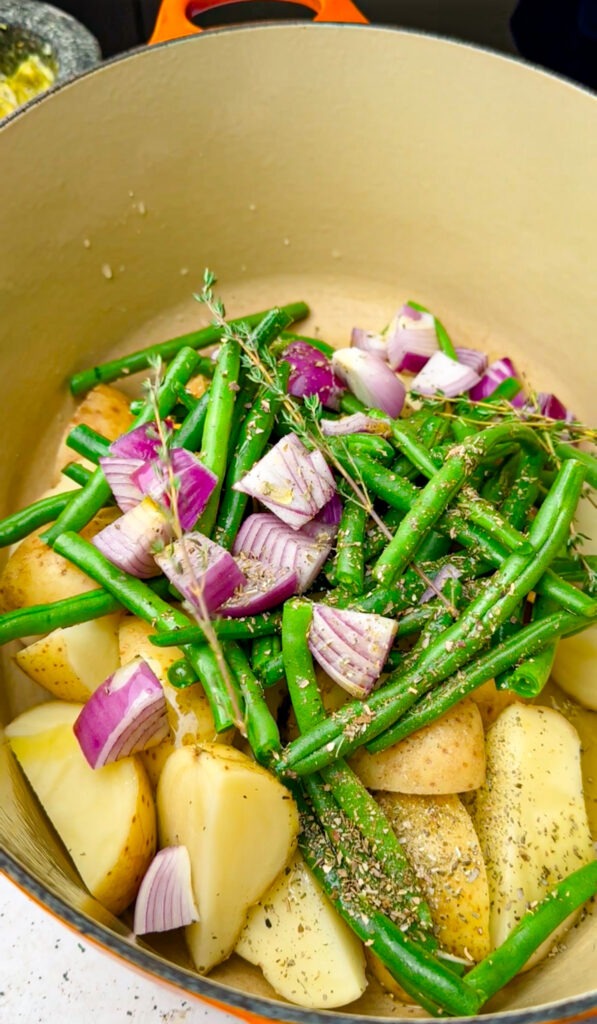
I add the potatoes, green beans and chunks of red onion directly to the bottom of a large Dutch oven with olive oil, thyme, oregano, salt and pepper.
The leg of lamb sits directly on top.
Then I add a whole garlic bulb and white wine or stock before covering the pot and letting the oven do most of the work.
As the lamb cooks, its juices run into the vegetables below.
That is where so much of the flavour comes from.
The Garlic, Lemon and Herb Marinade
The marinade is simple, but every ingredient has a purpose.
I use crushed garlic, olive oil, fresh thyme, dried oregano, mustard, crushed bay leaf, lemon zest, fresh lemon juice, salt and black pepper.
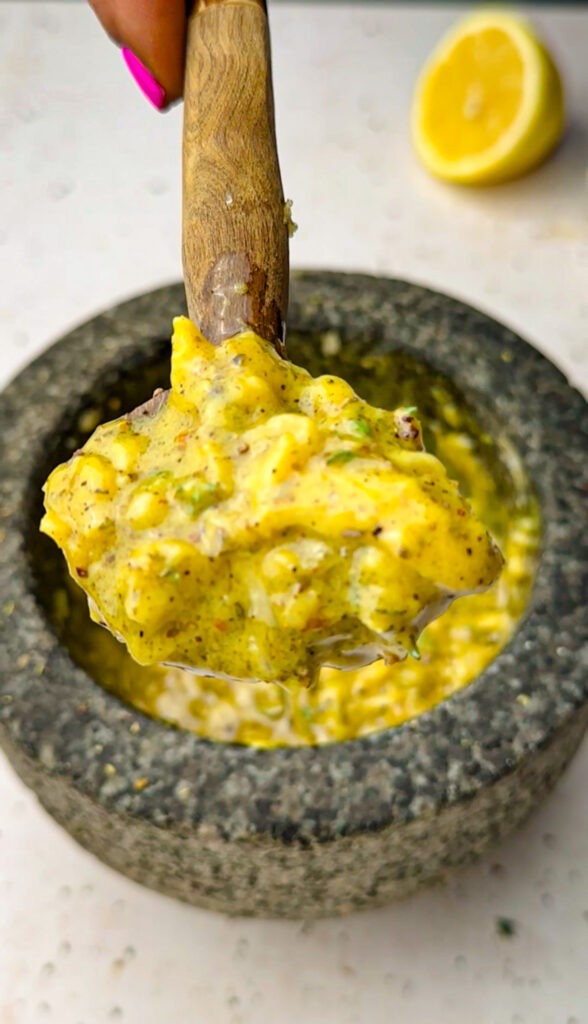
I mix everything together in my pestle and mortar until it becomes a thick paste.
You can absolutely mix it in a bowl, but I like using the mortar because crushing the garlic, herbs, lemon zest and seasoning together creates a marinade that really clings to the lamb.
The mustard gives the marinade depth and helps it stick.
The lemon adds freshness and cuts through the richness of the lamb.
And garlic and lamb are simply meant to be together.
Why Make Slits in the Lamb?
Before adding the marinade, I make small slits all over the leg with a sharp knife.
Those little cuts give the marinade somewhere to settle.
Instead of all the garlic and herbs sitting on the outside of the meat, you can work some of that flavour into the surface of the lamb.
Once the slits are made, I spoon over the marinade and massage it thoroughly into the meat.
And by massage, I mean really get in there.
This is not the moment to politely brush a little marinade over the top. 😂
Do You Need to Marinate a Leg of Lamb Overnight?
No.
If you are making this on the same day, you can coat the lamb and roast it immediately.
There is enough garlic, mustard, lemon and herbs in the marinade to give the lamb plenty of flavour.
If you are planning ahead, however, you can marinate it for a few hours or overnight.
That makes this a particularly useful recipe for Christmas or entertaining because you can get one of the main jobs done the day before.
If you refrigerate the lamb overnight, take it out before cooking so it loses some of its fridge chill before going into the oven.
Why I Roast the Lamb Covered First
This is not a traditional uncovered roast cooked on a dry tray from beginning to end.
I cook this lamb in a heavy Dutch oven with the lid on for most of the cooking time.
There is also white wine or stock in the bottom of the pot.
That creates a moist cooking environment and gives the lamb time to become tender without the outside drying out.
The vegetables underneath also release moisture as they cook.
Then, after approximately 2½ hours, I remove the lid.
The lamb goes back into the oven uncovered for another 20 to 30 minutes so the exterior can brown.
So you get the tenderness of the covered cook with that proper roasted finish at the end.
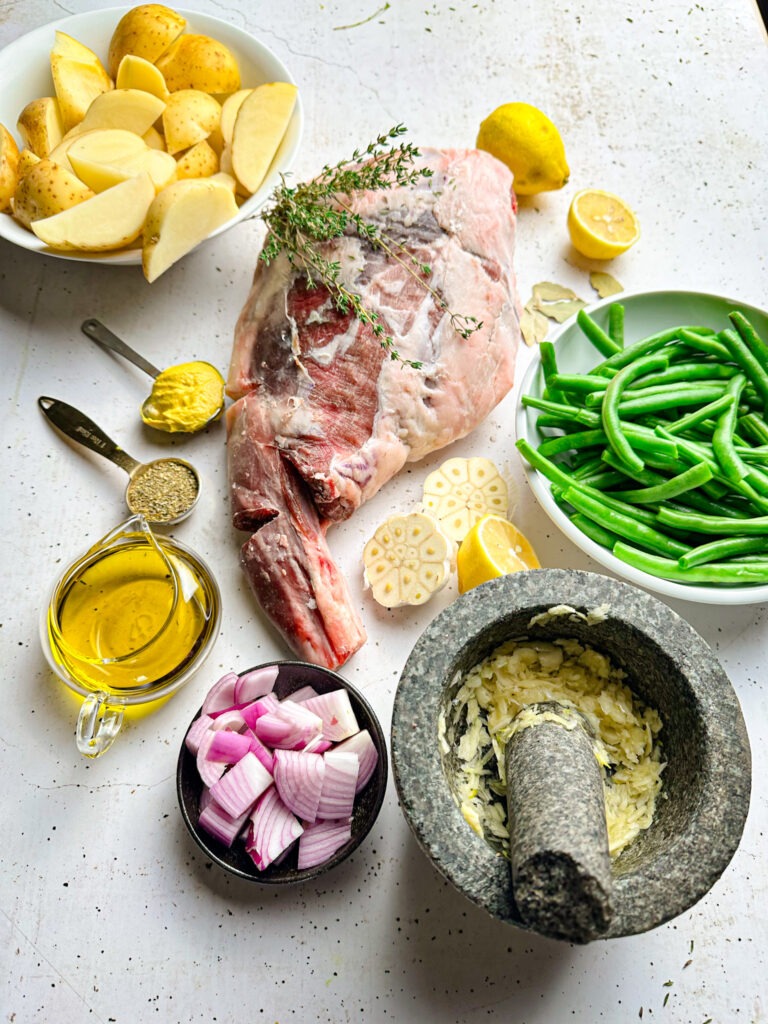
What Kind of Pot Should You Use?
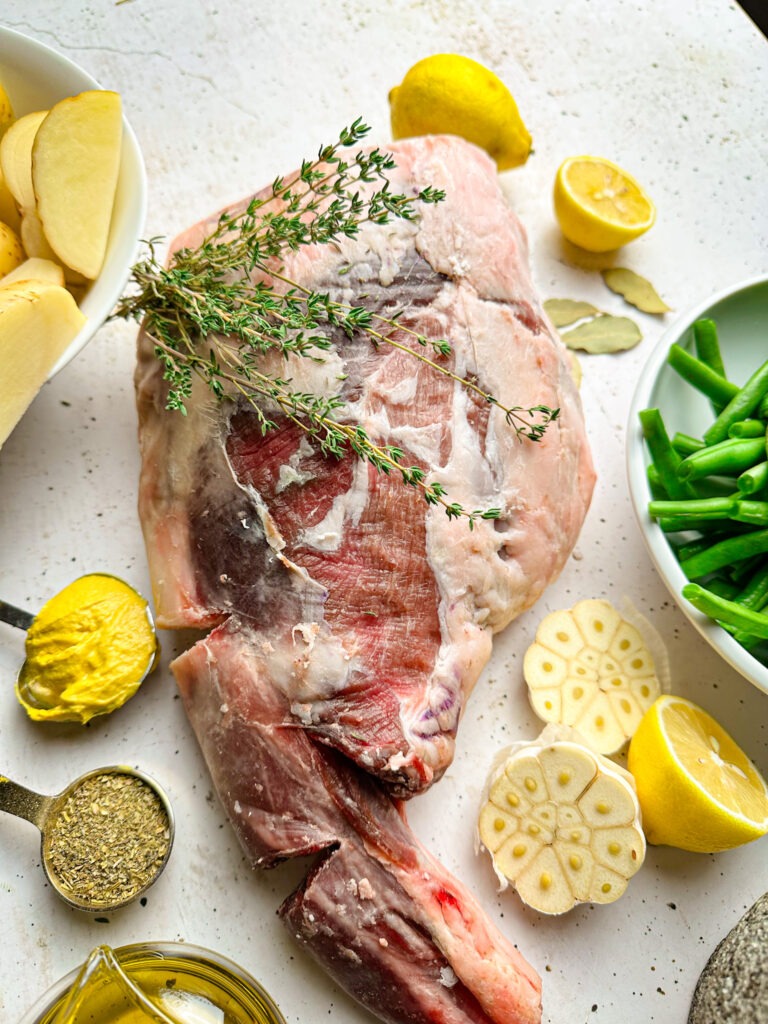
I used my 35 cm oval Le Creuset Dutch oven for this 2.2 kg leg of lamb.
You do not need the exact same pot.
What matters is having a large, deep, heavy ovenproof pot with enough room for the lamb and vegetables.
A cast-iron Dutch oven is ideal because it holds heat beautifully and the heavy lid traps moisture.
If you do not have one, use a deep roasting dish and cover it tightly with heavy-duty foil for the first part of the cooking time.
The key is not to pack the vegetables so tightly around the lamb that everything is overcrowded.
Why Put the Vegetables Under the Lamb?
Because that is where all the good stuff goes. 😂
The potatoes, beans and onion sit underneath the lamb and catch everything that drips from it as it roasts.
The olive oil.
The garlic and herbs.
The lemon.
The lamb juices.
The wine or stock.
The potatoes become incredibly savoury because they are essentially cooking in all those flavours.
The onions soften and sweeten.
The green beans become very tender and absorb the juices from the pot.
And the whole garlic bulb slowly roasts until the cloves are soft enough to squeeze straight out of their skins.
Do not throw that garlic away.
It is one of the best parts.
How to Make One-Pot Roast Leg of Lamb
1. Preheat the Oven
Preheat the oven to 175°C.
2. Make the Marinade
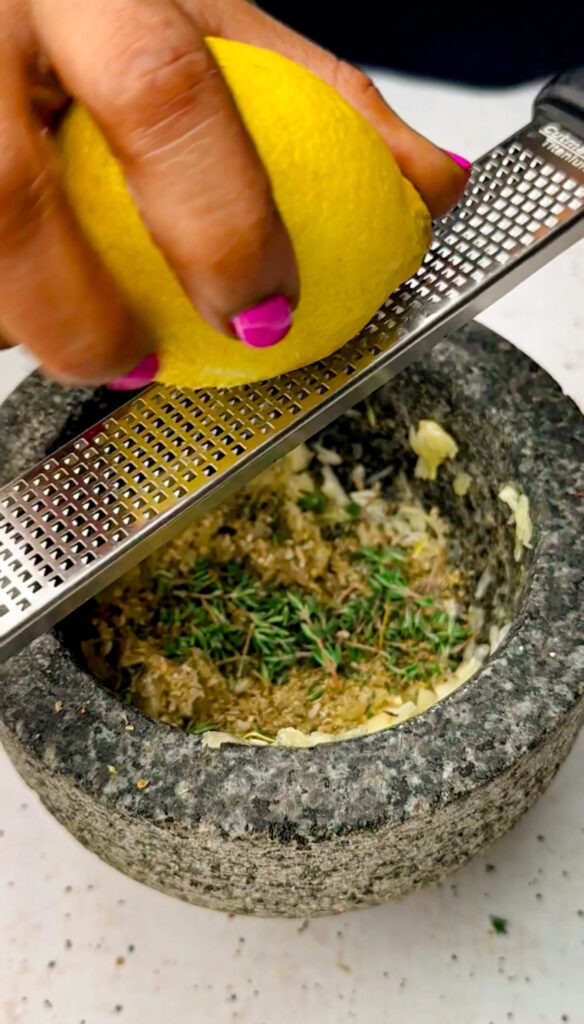
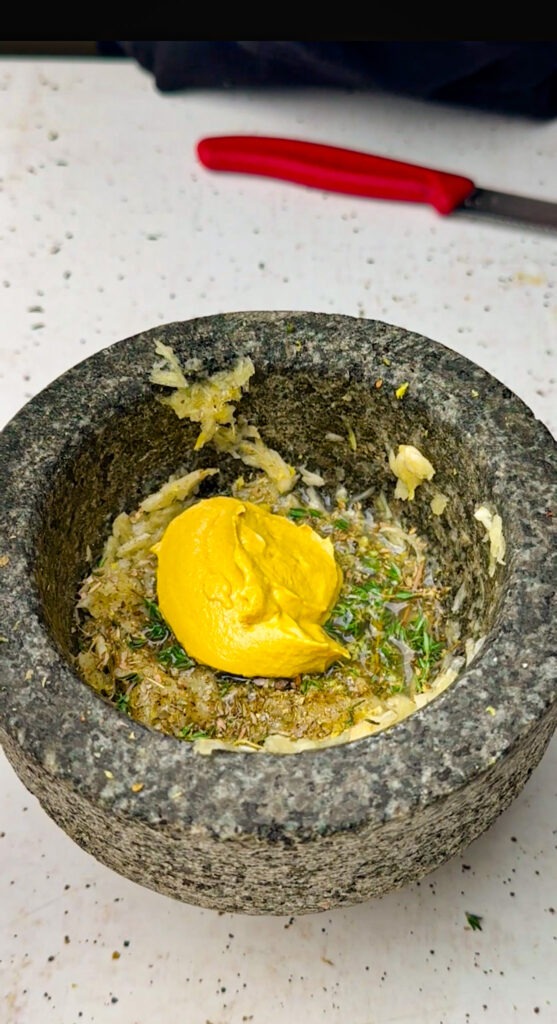
Add the crushed garlic, olive oil, chopped fresh thyme, half of the dried oregano, mustard, crushed bay leaf, lemon zest, lemon juice, salt and freshly ground black pepper to a pestle and mortar.
Work everything together until you have a thick paste.
3. Prepare the Vegetables
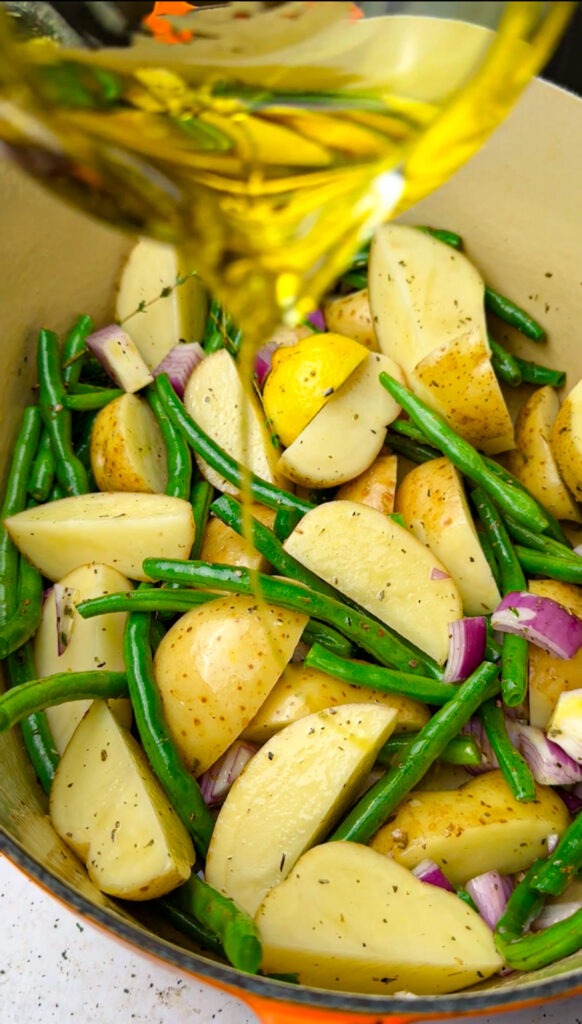
Add the potatoes, green beans and red onion to a large heavy-based Dutch oven.
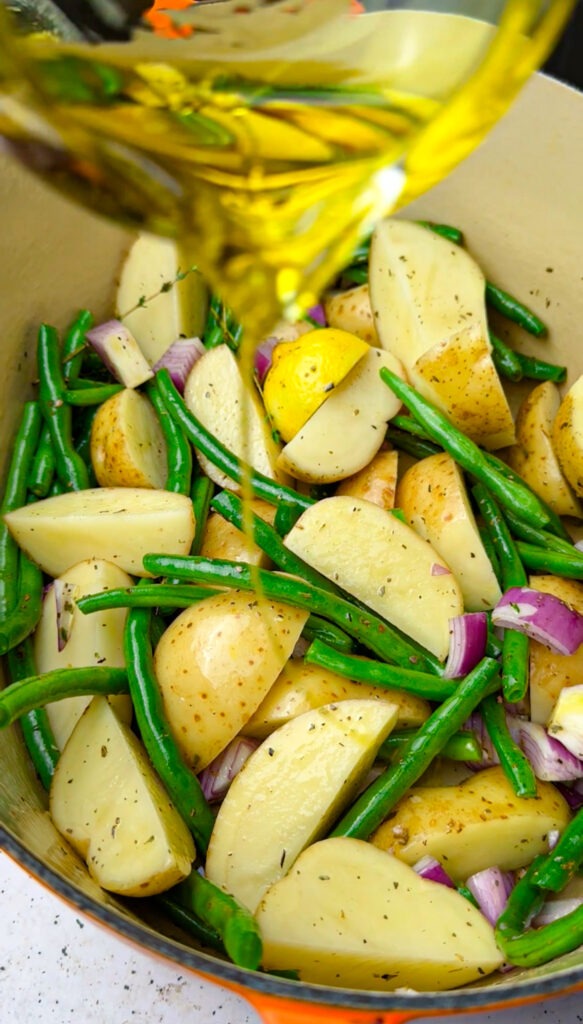
Add a few sprigs of thyme, the remaining oregano, a few generous glugs of olive oil and season with salt and pepper.
Mix everything together so the vegetables are lightly coated.
4. Add the Lamb
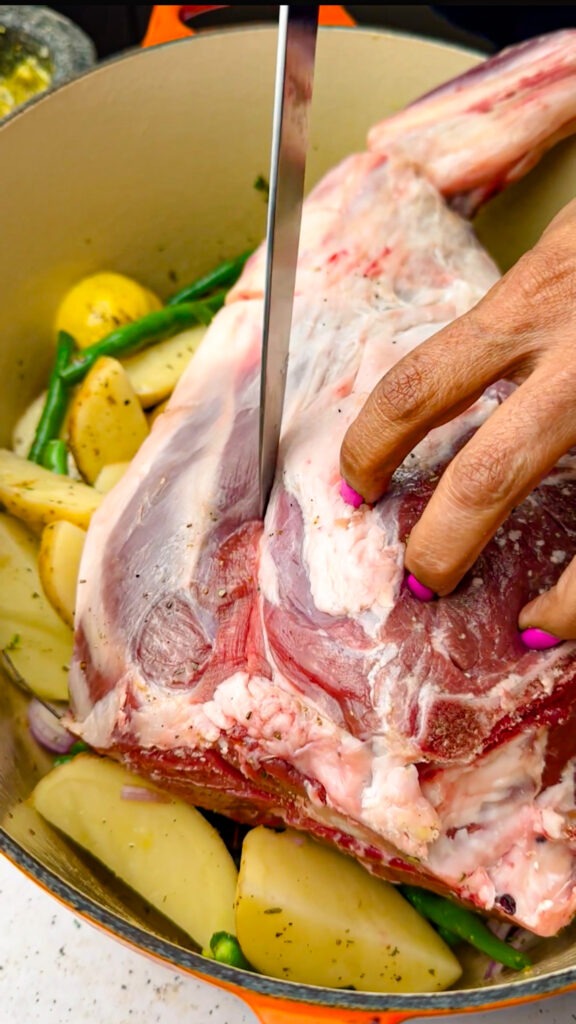
Place the leg of lamb directly on top of the vegetables.
Use a sharp knife to make several small slits over the lamb.
5. Massage in the Marinade
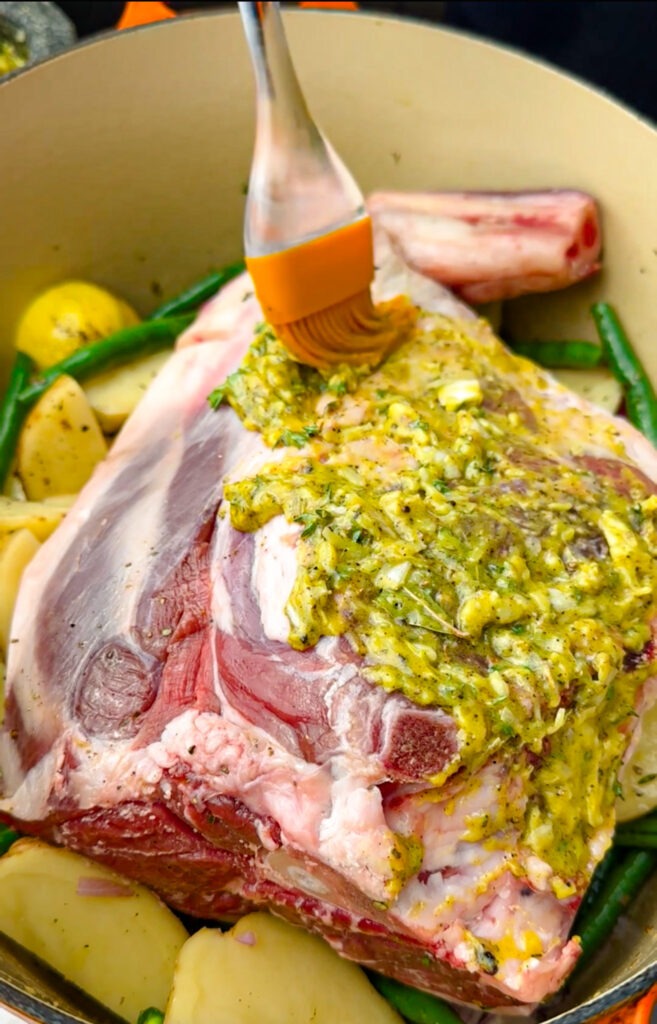
Spoon the marinade over the lamb.
Use your hands to massage it all over the meat and work some of the mixture into the slits.
Make sure the entire leg is well coated.
6. Add the Garlic and Liquid
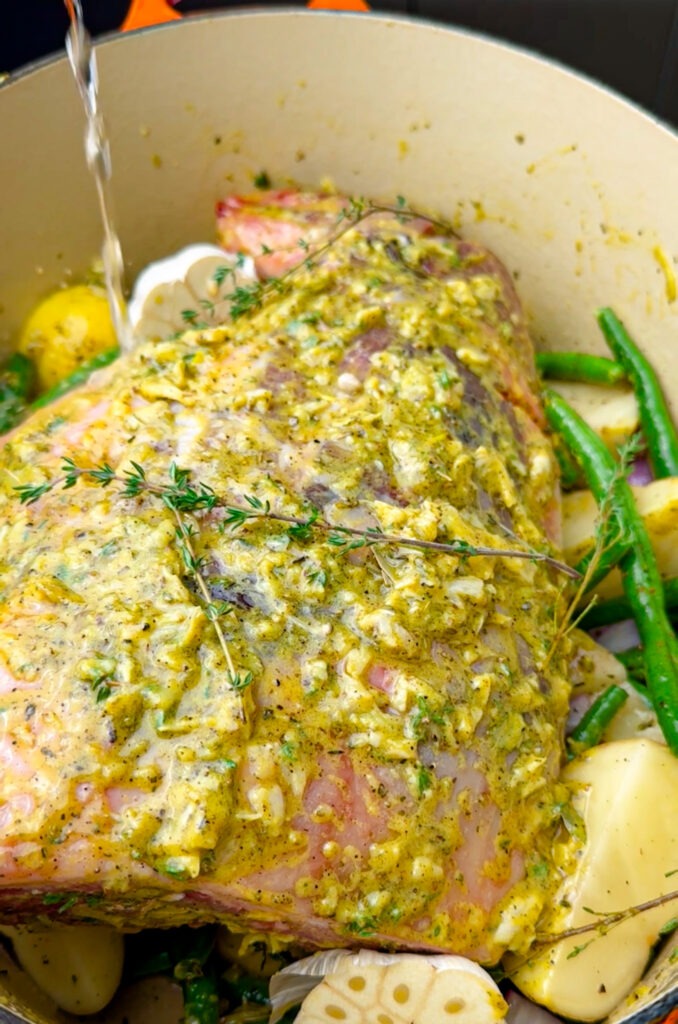
Cut the whole garlic bulb diagonally through the middle and add it to the pot.
Pour in 250 ml dry white wine or stock.
Pour it around the lamb rather than directly over the top so you do not wash off the marinade.
7. Cover and Roast
Cover the pot with the lid.
Place in the oven and roast for approximately 2½ hours.
Check the pot occasionally.
Be very careful when lifting the lid because there will be a lot of hot steam trapped inside.
Look at the liquid in the bottom of the pot.
If there is still plenty, leave it alone.
If the pot looks as though it is starting to dry out, add a small splash of hot stock.
8. Brown the Lamb
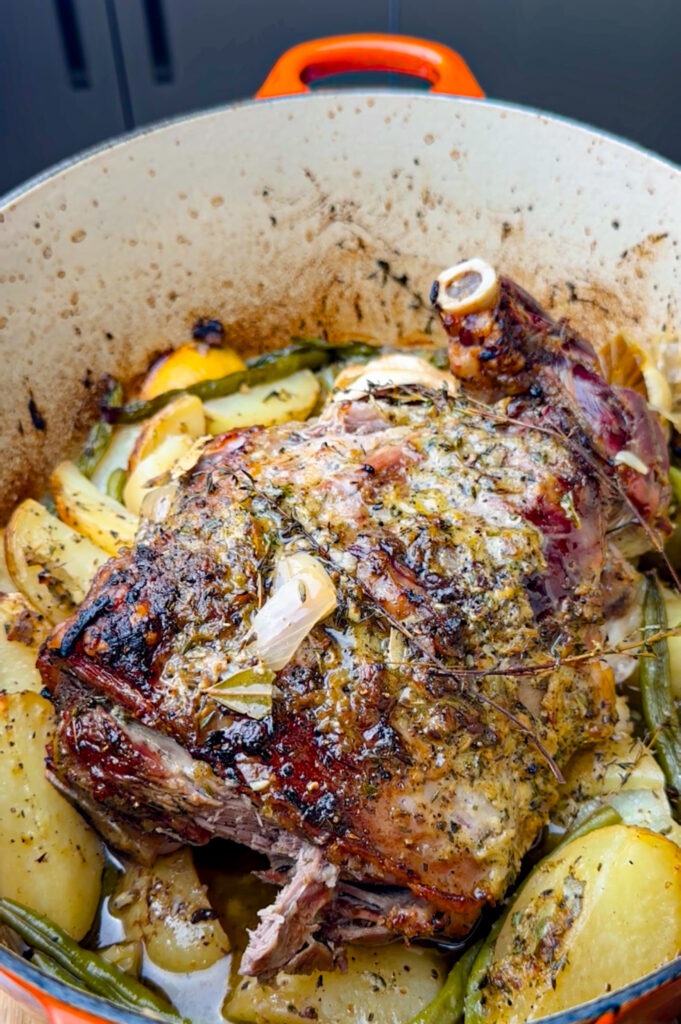
After approximately 2½ hours, remove the lid.
Return the pot to the oven and continue roasting uncovered for another 20 to 30 minutes until the outside of the lamb has developed a beautiful colour.
9. Rest the Lamb
Remove the lamb from the oven and allow it to rest for 10 to 15 minutes before carving.
This gives the juices inside the meat time to settle.
10. Serve
Slice the lamb and serve it with the potatoes, green beans, onions, roasted garlic and plenty of the juices from the bottom of the pot.
How Long Does a 2.2 kg Leg of Lamb Take to Cook?
For this recipe, my 2.2 kg leg of lamb cooks for approximately 2½ hours covered at 175°C followed by another 20 to 30 minutes uncovered.
This timing is specific to this recipe and method.
A traditional uncovered roast may have completely different cooking times.
The exact time can also vary depending on whether your lamb is bone-in or boneless, the shape of the leg, how thick it is, how cold it was before going into the oven, your individual oven and the size and material of your cooking pot.
Use cooking time as a guide rather than the only way of deciding whether your lamb is ready.
What Internal Temperature Should Roast Lamb Reach?
A meat thermometer removes a lot of guesswork when cooking a large roast.
Insert it into the thickest part of the lamb without touching the bone.
For food safety, whole lamb roasts should reach at least 63°C internally followed by a resting period.
You can cook lamb further depending on how you prefer it.
This particular recipe uses a long covered roasting method, so the result is intended to be tender and well cooked rather than a quick rare roast.
Bone-In vs Boneless Leg of Lamb
A bone-in leg and a boneless rolled leg will not necessarily cook at the same rate.
The bone changes the shape and thickness of the roast and a rolled leg can be much more compact.
If you use a different cut from the one I used, start checking it earlier.
A thermometer and the tenderness of the meat are far more useful than assuming every 2 kg roast needs exactly the same amount of time.
Should You Use White Wine or Stock?
Both work beautifully.
I like dry white wine because it gives the pan juices a little acidity and depth.
If you do not cook with alcohol, use lamb stock or chicken stock.
You could even use mostly stock and finish the pan juices with a squeeze of lemon for a little brightness.
You do not need loads of liquid.
The lamb is roasting, not boiling.
The liquid is there to provide moisture during the long covered cook and to create those beautiful juices at the bottom of the pot.
Why Do You Need to Check the Liquid?
Every leg of lamb behaves slightly differently.
Some release more juice and fat than others.
Different pots also hold onto moisture differently.
That is why I check mine a couple of times during the long roast.
If the bottom of the pot is still juicy, leave it alone.
If it is beginning to dry out before the lamb and potatoes are ready, add a little hot stock.
Do not keep adding liquid unnecessarily.
You want rich roasting juices, not vegetables swimming in broth.
Do the Green Beans Become Soft?
Yes.
And in this recipe, that is intentional.
The beans are not meant to come out bright green and crisp like quickly steamed beans.
They cook slowly underneath the lamb and absorb the meat juices, herbs and wine or stock.
They become very tender.
I love them like this because they almost become part of the sauce and vegetable base.
If you prefer firmer green beans, simply add them later in the cooking time.
What Potatoes Are Best for Roast Lamb?
Use a potato that holds its shape reasonably well during a long cook.
Because these potatoes sit underneath the lamb for several hours, you do not want them cut too small.
Medium potatoes cut into substantial chunks work well.
Very small cubes are more likely to break down.
And honestly, if the edges get slightly soft and start absorbing those lamb juices, I am not complaining.

Why Roast a Whole Garlic Bulb?
Roasting completely changes garlic.
Raw garlic is sharp and punchy.
Slow-roasted garlic becomes sweet, mellow and almost creamy.
When the lamb is ready, squeeze the cloves from their skins.
You can serve them directly with the meat or mash them into some of the pan juices.
If you like garlic, do not skip this part.
Can You Use Different Vegetables?
Absolutely.
This method works particularly well with vegetables that can handle longer cooking.
- Carrots
- Baby potatoes
- Butternut
- Sweet potatoes
- Parsnips
- Whole baby onions
More delicate vegetables should be added later so they do not completely collapse during the long cooking time.
How to Make Gravy from the Pan Juices
You may find that the pan juices are already good enough to serve exactly as they are.
That is usually what I do.
But if you want a thicker gravy, remove the lamb and vegetables once they are cooked.
Place the pot over medium heat.
Skim away excess fat if necessary and allow the liquid to simmer and reduce.
For a thicker gravy, mix a small amount of cornflour with cold water and stir it into the simmering juices.
Cook until thickened.
Taste before adding any extra salt because the stock and lamb juices are already seasoned.
What to Serve with Roast Leg of Lamb
Because you already have potatoes, green beans and onions in the pot, you technically have a complete dinner.
For a normal Sunday lunch, I would happily serve it just like that.
If you are making a larger spread, add:
- Roasted carrots
- Butternut
- Cauliflower cheese
- Peas
- A fresh green salad
- Mint sauce
- Extra gravy
And absolutely serve the roasted garlic.
Is Roast Leg of Lamb Good for Christmas?
Yes, and this particular recipe is actually very useful for Christmas.
You are cooking your lamb and several of your side dishes together.
That means fewer roasting trays taking up valuable oven space and fewer pans to wash afterwards.
You can also make the marinade ahead of time and prepare most of the vegetables earlier.
Then on Christmas Day, assemble everything in the Dutch oven and let it cook.
Once sliced, the lamb looks beautiful on a large platter surrounded by the potatoes, vegetables and roasted garlic.
It makes a proper centrepiece without requiring you to spend the entire day in the kitchen.
Roast Lamb for Sunday Lunch
This might actually be my favourite way to serve it.
There is something very comforting about putting a roast into the oven and letting it slowly cook while you get on with the rest of the day.
After the initial preparation, there is not much work involved.
Check the liquid every so often.
Remove the lid towards the end.
Let the lamb brown.
Meanwhile, the whole house smells like garlic, herbs and roast lamb.
Which is surely half the pleasure of making Sunday lunch.
Can You Prepare Roast Lamb the Day Before?
Yes.
Make the marinade and coat the lamb.
Cover and refrigerate overnight.
You can also peel and cut the potatoes and prepare the onion ahead.
I would prepare the beans closer to cooking time.
When you are ready to cook, assemble everything in the pot, add the wine or stock and roast as usual.
Why Do You Rest Roast Lamb?
Do not carve a large roast the second it comes out of the oven.
I know it is tempting.
The kitchen smells incredible and everyone is probably asking when lunch is ready.
Give it 10 to 15 minutes.
Resting allows the juices inside the meat to redistribute.
If you carve immediately, more of those juices end up running onto the cutting board.
The vegetables will stay perfectly warm in the Dutch oven while the meat rests.
How to Carve a Leg of Lamb
Use a sharp carving knife.
Start at the thickest, meatiest part of the leg and slice across the grain where possible.
As you reach the bone, turn the leg and continue carving from another side.
Do not worry about every slice looking identical.
Some people are going to want the crisp, browned outside pieces.
Others will immediately start hunting for the soft meat closer to the bone.
There is room for everyone. 😂
How to Store Leftover Roast Lamb
Allow leftovers to cool, then transfer them to an airtight container and refrigerate.
Keep some of the pan juices with the meat if you can.
That helps keep the lamb moist when you reheat it.
Reheat gently until piping hot rather than repeatedly heating the whole batch.
What to Make with Leftover Roast Lamb
Leftover roast lamb is one of those leftovers I actively look forward to.
- Lamb sandwiches
- Pita pockets
- Wraps with yoghurt and salad
- Lamb salad
- Shepherd’s pie
- A quick leftover lamb curry
- Loaded potatoes
- Lamb rolls with mint sauce
You can also slice it cold for sandwiches the next day.
Air Fryer Roast Lamb or Oven Roast Lamb?
I have an Air Fryer Roast Lamb recipe on PriMade Food too.
That version is perfect when you are cooking a smaller roast, feeding fewer people or simply want to use the air fryer instead of turning on the oven.
This recipe serves a different purpose.
I would choose this one-pot oven roast when I have a larger leg of lamb and want the potatoes and vegetables cooking underneath it at the same time.
Both deserve a place in the recipe collection because they solve completely different dinner problems.
More Lamb Recipes You May Enjoy
- Air Fryer Roast Lamb
- Lamb Chops Fry
- Lamb Chops Chutney
- Durban Mutton Curry
- Lamb and Green Beans Curry
- Lamb and Brinjal Curry
My Tips for the Best Roast Leg of Lamb
Season properly.
A 2.2 kg piece of meat needs enough seasoning.
Use fresh lemon.
Both the zest and juice bring freshness to the rich lamb.
Make the slits before adding the marinade.
This gives the garlic and herb paste somewhere to settle.
Massage the marinade in properly.
Get it over the entire leg and into those cuts.
Use a large enough pot.
The vegetables need some breathing room underneath and around the lamb.
Check the liquid, but don’t fuss.
If the pot still has plenty of juices, leave it alone.
Be careful with the lid.
A covered Dutch oven traps a surprising amount of hot steam.
Uncover it at the end.
This gives the lamb that gorgeous roasted colour.
Use a meat thermometer if you own one.
It is especially useful when cooking a large roast.
Rest before carving.
Give it at least 10 to 15 minutes.
Do not throw away the pan juices.
I repeat, do not throw away the pan juices. 😂
Frequently Asked Questions
What temperature do you cook a leg of lamb?
For this recipe, I cook the lamb at 175°C.
The lamb is covered for most of the cooking time and then uncovered for the final 20 to 30 minutes.
How long does a 2.2 kg leg of lamb take?
Mine takes approximately 2½ hours covered plus another 20 to 30 minutes uncovered.
Always use timing as a guide because different legs and ovens can cook differently.
Should I cover lamb while roasting?
It depends on the method.
For this recipe, yes.
The covered pot helps keep moisture inside while the lamb and vegetables slowly cook.
I remove the lid at the end so the lamb can brown.
Do I need to sear the lamb first?
No.
There is no separate searing step.
The lamb gets its colour during the final uncovered roasting time.
Can I roast potatoes in the same pot as lamb?
Yes, and it is one of my favourite things about this recipe.
The potatoes cook underneath the lamb and absorb all the pan juices.
Can I use stock instead of wine?
Absolutely.
Use lamb or chicken stock.
Can I leave out the green beans?
Yes.
You can simply use potatoes and onion or replace the beans with another vegetable.
Can I use a boneless leg of lamb?
Yes, but it may cook differently.
Check temperature and tenderness rather than relying only on the timings for a bone-in leg.
How long should roast lamb rest?
I give mine at least 10 to 15 minutes before carving.
Is this good for Christmas lunch?
Absolutely.
The one-pot method is especially useful for Christmas because your lamb and vegetables are cooking together, leaving you with more oven space and fewer dishes.
A Roast That Looks Like More Work Than It Is
That is probably my favourite thing about this recipe.
When you put the lamb on the table with the potatoes, green beans, onion and roasted garlic, it looks like you have spent the entire day making a proper roast dinner.
Meanwhile, most of the time the Dutch oven has quietly been doing the work for you.
The garlic, mustard, lemon and herbs flavour the lamb.
The lamb flavours the vegetables.
The vegetables, wine or stock and roasting juices create that gorgeous liquid at the bottom of the pot.
And it all happens together.
Sunday lunch?
Absolutely.
Easter?
Definitely.
Christmas?
This is going straight back onto the menu.
And if all I have to wash afterwards is one Dutch oven and the pestle and mortar, I am very happy with that arrangement. 😂❤️
Life is too short to eat bland food.
Roast Leg of Lamb
A tender one-pot roast leg of lamb coated in a garlic, lemon, mustard and herb marinade, then slowly roasted over potatoes, green beans, onion and whole garlic. Everything cooks together in the delicious lamb juices for an easy family roast with less washing up.

Ingredients
Instructions
-
Preheat the oven to 175°C.
-
Add the crushed garlic, 3 tablespoons olive oil, chopped thyme, ½ tablespoon dried oregano, mustard, crushed bay leaf, lemon zest, lemon juice, salt and black pepper to a pestle and mortar.
-
Work everything together until you have a thick garlic and herb marinade.
-
Add the potatoes, green beans and red onion to a large heavy-based Dutch oven or ovenproof casserole.
-
Add the remaining ½ tablespoon dried oregano, a few sprigs of fresh thyme and a generous drizzle of olive oil.
-
Season with salt and freshly ground black pepper and toss the vegetables until lightly coated.
-
Place the leg of lamb directly on top of the vegetables.
-
Using a sharp knife, make several small slits over the surface of the lamb.
-
Spoon the marinade over the lamb and massage it thoroughly over the entire surface, working some of the marinade into the slits.
-
Add the halved garlic bulb to the pot.
-
Pour the white wine or stock around the lamb and vegetables rather than directly over the meat.
-
Cover the pot tightly with the lid.
-
Roast for approximately 2½ hours.
-
Check the pot occasionally during cooking, taking care when lifting the lid as hot steam will escape.
-
Check that there is still some liquid at the bottom of the pot.
-
If the pot begins to dry out, add a small splash of hot stock.
-
After 2½ hours, remove the lid.
-
Return the pot to the oven and roast uncovered for a further 20–30 minutes, or until the lamb is beautifully browned.
-
Check that the lamb is cooked to your preferred doneness. If using a meat thermometer, insert it into the thickest part without touching the bone.
-
Remove the pot from the oven.
-
Allow the lamb to rest for 10–15 minutes before carving.
-
Slice the lamb and serve with the potatoes, green beans, onion, roasted garlic and pan juices.
Note
LAMB:
I used a 2.2 kg leg of lamb. Cooking time can vary depending on the size, thickness and shape of your lamb as well as your oven.
POT:
I used a 35 cm oval Le Creuset Dutch oven. Use any large, heavy ovenproof pot with a well-fitting lid that comfortably fits the lamb and vegetables.
MARINADE:
I make the marinade in a pestle and mortar so the garlic, herbs, lemon and seasoning form a thick paste that clings to the lamb. A bowl can also be used.
MARINATING:
The lamb can be cooked immediately after adding the marinade or marinated in the fridge for several hours or overnight.
WINE OR STOCK:
Use dry white wine for extra depth or substitute lamb or chicken stock if you prefer not to cook with wine.
LIQUID:
Check the pot occasionally during cooking. Add a small amount of hot stock only if the bottom of the pot begins to dry out.
GREEN BEANS:
The green beans become very tender during the long cooking time and absorb the lamb juices. If you prefer firmer beans, add them later in the cooking process.
POTATOES:
Cut the potatoes into fairly large pieces so they hold their shape during the long roast.
GARLIC:
Do not discard the roasted garlic bulb. The cloves become soft and sweet and can be squeezed from their skins and served with the lamb.
RESTING:
Rest the lamb for at least 10–15 minutes before carving to allow the juices to redistribute.
INTERNAL TEMPERATURE:
Whole lamb roasts should reach at least 63°C in the thickest part followed by a resting period. Cook further according to your preferred doneness.
SERVING:
Serve with the vegetables and plenty of the pan juices. For a larger meal, add roasted vegetables, cauliflower cheese, salad or mint sauce.


