


There are some dishes that take me straight back to growing up in Durban and mutton and cabbage curry is one of them.
It is not fancy food. It is everyday food. The kind of curry that belonged in our homes long before recipes were written down, photographed and shared online. A pot of meat, a generous amount of cabbage, Durban masala and something warm on the side to scoop it all up.
Growing up, we simply knew this dish as mutton and cabbage.
In Durban Indian homes back then, it was often cooked using the rib or breast meat of the sheep, which we called mutton. Breast meat has quite a bit of fat running through it and as it slowly cooks, that fat renders into the curry and gives the cabbage an incredible richness.
My version has changed slightly over the years.
I prefer using lamb leg cut into curry pieces. It is the cut I enjoy eating more than breast meat and it still gives me a beautifully rich curry without quite as much fat.
That is one of the things I love about recipes passed through families and communities. They do not have to remain frozen in time. We carry the foundations with us, then slowly adapt them to the way we cook and eat today.
The heart of the dish, though, is still very much the cabbage and mutton I remember from Durban.
The lamb is cooked first in a rich tomato and Durban curry powder base until it begins to tenderise and release its own juices. Then a generous amount of sliced cabbage goes into the pot and slowly cooks down with the meat.
The cabbage is not simply a vegetable added to the curry. It becomes part of the curry, absorbing the masala, the tomatoes and all those beautiful juices from the lamb.
That is when humble cabbage becomes something quite special.
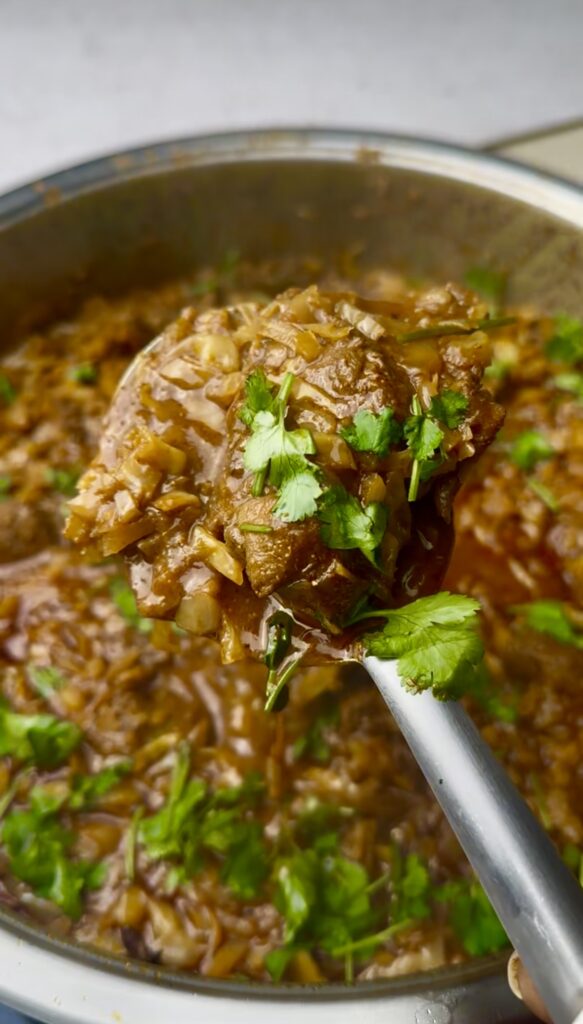
Why You’ll Love This Mutton and Cabbage Curry
- It is proper home-style comfort food with rich Durban Indian flavour.
- The cabbage becomes part of the curry rather than simply being added as a vegetable on the side.
- The lamb cooks in its own juices first which helps build deeper flavour.
- It is generous and satisfying with meat and vegetables cooked together in one pot.
- You can make it with lamb leg, breast meat or ribs depending on your preference.
The Durban Way: Breast Meat, Ribs and Mutton
If you grew up around Durban Indian cooking, you will probably understand immediately when I say mutton.
Technically, lamb and mutton are different. Lamb comes from a younger sheep while mutton comes from an older sheep or in other parts of the world it comes from goat. But in the Durban Indian community, the word mutton became part of our everyday food language and was often used much more broadly.
You did not necessarily ask what age the sheep was. It was mutton curry, mutton biryani, beans and mutton or, in this case, mutton and cabbage.
Years ago, breast meat and ribs were particularly well suited to dishes like this.
These fattier cuts worked beautifully with vegetables. As the meat cooked slowly, the fat rendered into the pot and flavoured everything around it. With cabbage especially, that richness works incredibly well because the cabbage absorbs so much of what it is cooked with.
It was also practical cooking. Different cuts of meat were used for different dishes and vegetables helped turn meat into generous meals that could feed a family.
Today I use lamb leg because that is my personal preference, but using breast meat or ribs takes this dish straight back to the way many Durban Indian families would have cooked it.
If You Use Lamb Breast or Ribs
You can absolutely make this recipe with lamb or mutton breast and rib pieces instead of lamb leg.
The one adjustment I would make is to reduce the amount of oil at the beginning.
Breast and rib meat contain more fat than lamb leg and that fat will render as the meat cooks. Starting with the full amount of oil can leave you with a curry that is richer and oilier than you want.
Use just enough oil to get your onions and whole spices going, then allow the meat to provide the rest of that richness naturally.
With lamb leg, I use about 3 tablespoons of oil because the meat is considerably leaner.
Why Cabbage and Meat Belong Together
There is something about the way vegetables were cooked with meat in the Durban Indian kitchen that I think is worth holding onto.
Mutton and Cabbage. Beans and mutton. Green beans with lamb. Potatoes cooked directly in curry.
Vegetables were not always treated as a completely separate side dish. They became part of the pot.
And perhaps that is why these dishes taste so comforting.
The cabbage cooks in the same masala as the lamb. It absorbs the meat juices. It takes on the spices. It releases its own moisture and gradually collapses into the curry.
By the time the pot is ready, you are not eating lamb curry with cabbage added to it.
You are eating cabbage and mutton.
And there is a difference.
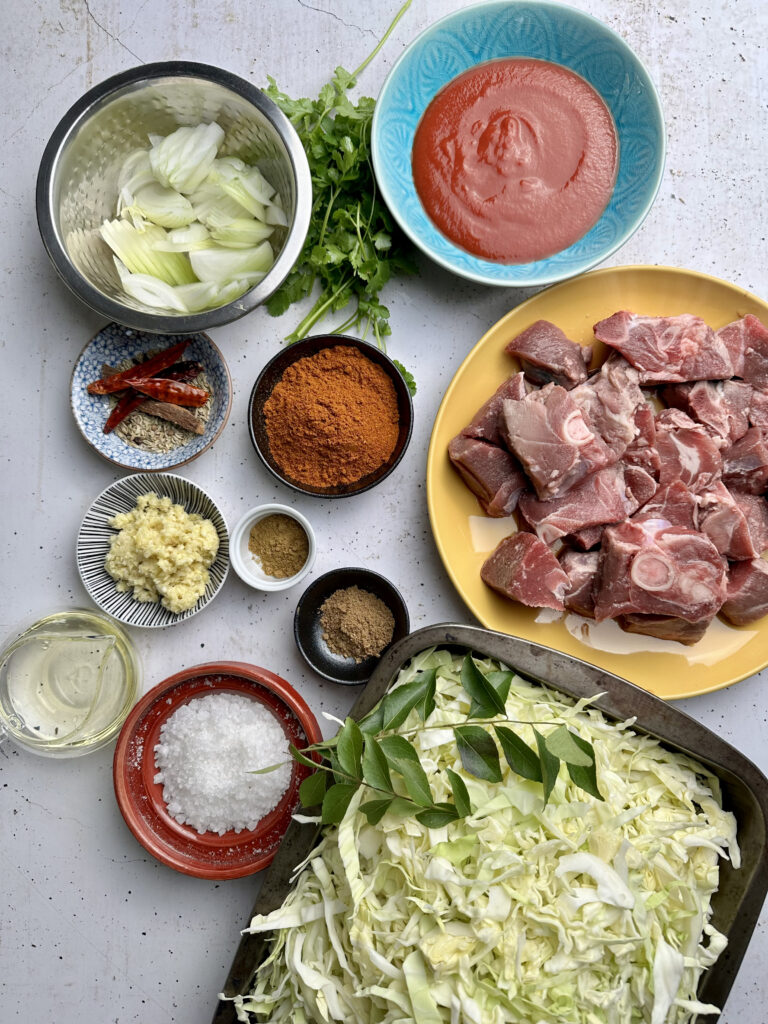
Why Cabbage Works So Well in Curry
Cabbage is one of those ingredients that can look incredibly humble before it goes into the pot, but it is brilliant at taking on flavour.
As it cooks, it softens and releases moisture. At the same time, it absorbs the tomatoes, Durban curry powder, lamb juices and whole spices around it.
The result is cabbage that is soft, savoury and deeply flavoured rather than simply boiled or steamed.
The slight natural sweetness of cabbage also balances the richness of the lamb beautifully.
It is exactly the sort of vegetable that proves you do not need expensive ingredients to create something deeply satisfying.
How to Make Mutton and Cabbage Curry
There are a few stages to this curry and giving each one enough time makes a real difference to the finished dish.
Start with the Whole Spices
Heat the oil in a large, heavy-based pot over medium heat.
Add the biryani mix and dried red chillies and fry for about a minute. You are not trying to brown the spices. You simply want the heat from the oil to wake them up and release their fragrance.
Once you can smell those warm spices, add the sliced onion.
Allow the onions to soften and begin caramelising. This forms an important part of the curry base, so give them a little time.
Add the Ginger, Garlic and Durban Curry Powder
Lower the heat slightly before adding the ginger and garlic paste.
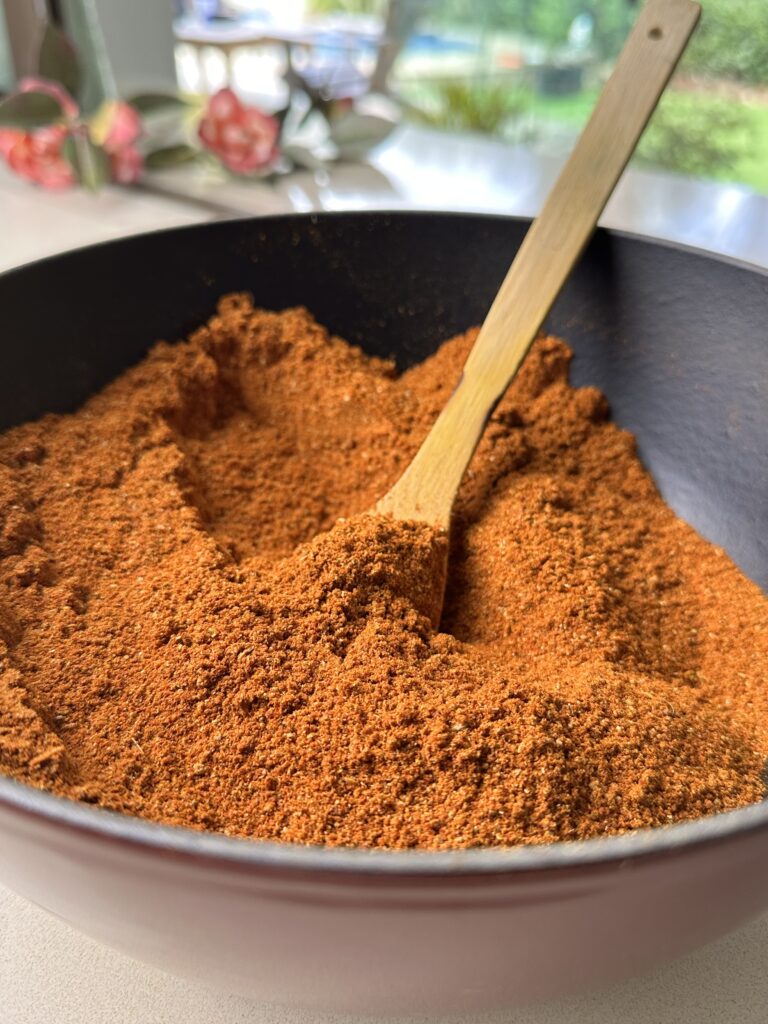
Mix well and fry for about a minute before adding the Durban curry powder, click for the recipe.
Stir everything together so the masala coats the onions.
Ground spices can burn quickly, so keep an eye on the heat. If the masala starts catching at the bottom of the pot, add just a small splash of water.
You are not adding water to make gravy at this stage. It is simply there to stop the spices from burning while they cook.
Build the Tomato Masala
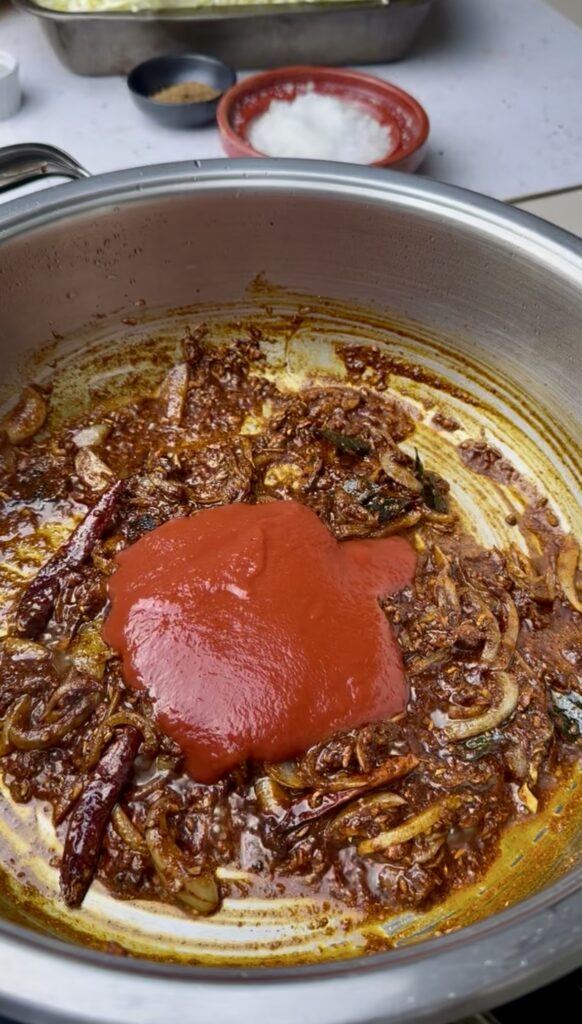
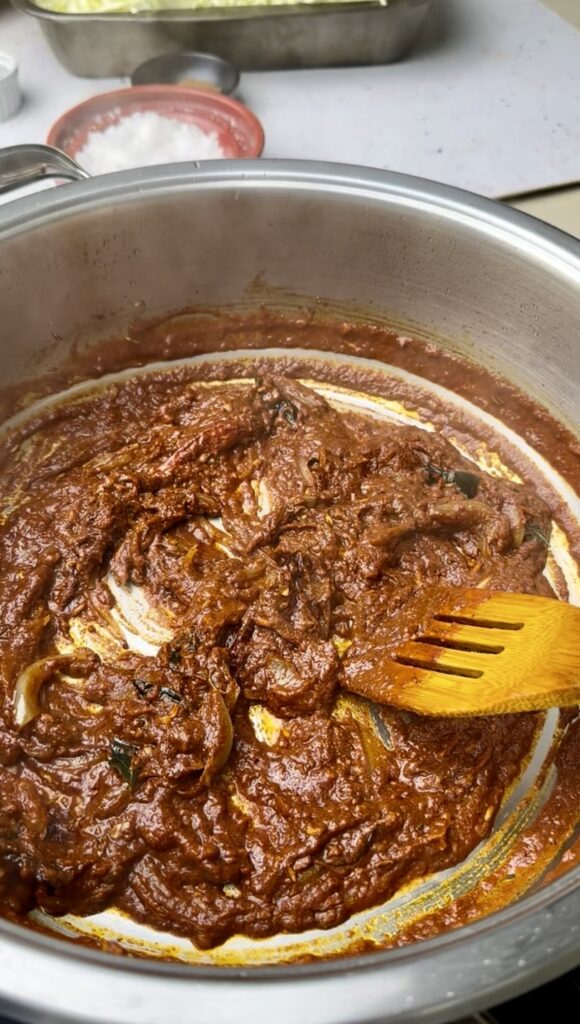
Add the crushed tomatoes and mix everything together well so the onions, spices and tomato become one masala.
Season with coarse salt according to taste.
Allow the tomato masala to cook for about 4 minutes before adding the lamb.
I personally prefer crushed tomatoes in this curry because I find they give me a better consistency in the finished gravy.
Fresh tomatoes can absolutely be used. I would use around 2 to 3 fresh tomatoes, depending on their size.
It really comes down to personal preference.
Add the Lamb
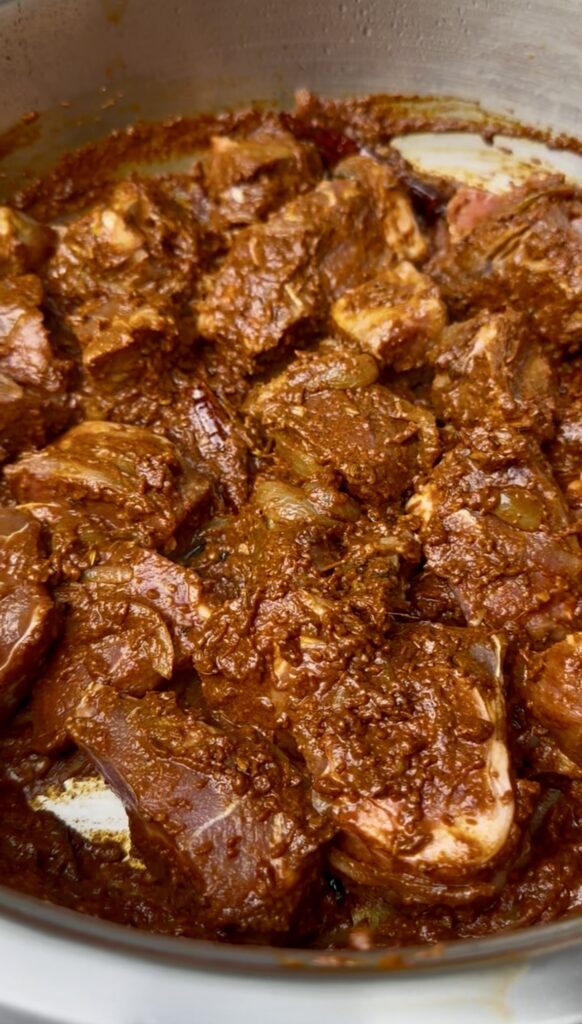
Add the lamb pieces and mix well so every piece is coated in the tomato masala.
Cover the pot and cook over medium heat for approximately 30 to 35 minutes.
At this stage, do not automatically add water.
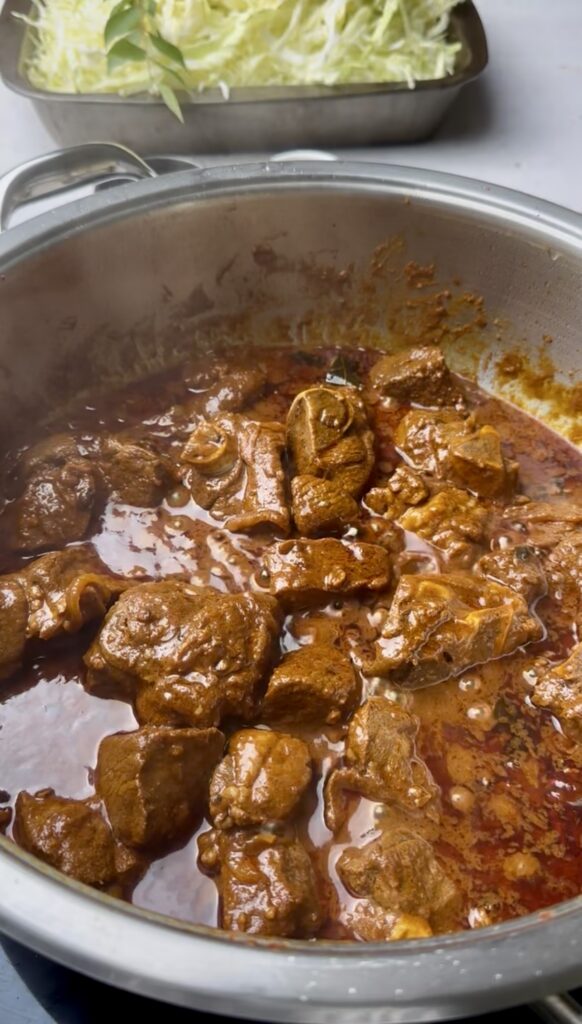
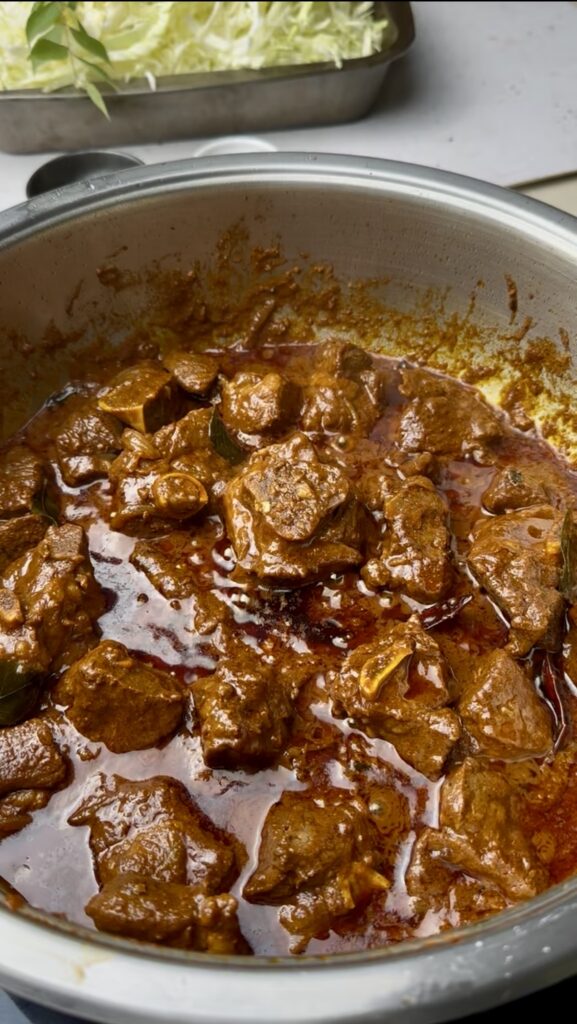
The lamb will begin releasing its own juices as it cooks. Those juices combine with the masala and help build the flavour of the curry naturally.
Check the pot from time to time and give everything a stir.
If it genuinely begins catching before enough moisture has been released, add just a small amount of water.
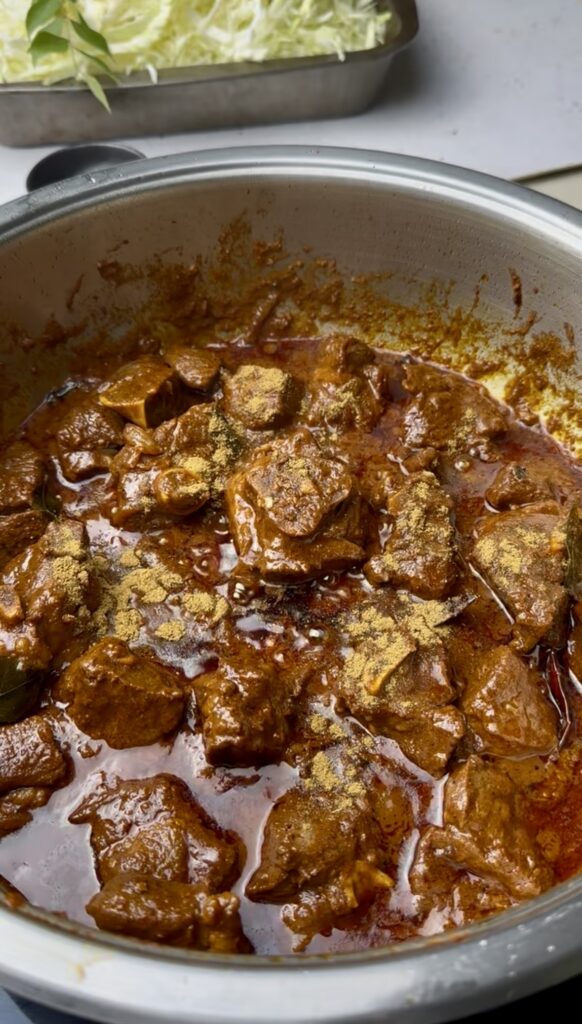
After the lamb has had its initial cooking time, add the ground jeera and dhania powder and mix well.
When to Add the Cabbage
I like to give the lamb a good head start before adding the cabbage.
This is important because cabbage and lamb do not cook at the same rate. If everything goes into the pot together from the beginning, the cabbage can become completely overcooked before the meat is tender.
After the lamb has cooked for around 30 to 35 minutes, add the sliced cabbage.
Eight hundred grams may look like an enormous amount when it first goes into the pot.
Do not worry. Cabbage reduces dramatically as it cooks.
Give everything a really good toss so the cabbage begins mixing through the lamb and masala.
Cover the pot and allow it to cook gently for another 45 minutes to 1 hour, or until the lamb is tender and the cabbage is soft.
As the cabbage cooks, it releases its own moisture and absorbs the flavour from the meat and masala.
This is why I would not automatically add lots of water when the cabbage goes in.
You want the cabbage cooking in the curry, not boiling in a pot of excess water.
Step-by-Step: How to Cook Mutton and Cabbage Curry
Step 1: Heat the Whole Spices
Add the oil to a large heavy-based pot over medium heat.
Add the biryani mix and dried red chillies and fry for about 1 minute until fragrant.
Step 2: Add the Onions
Add the sliced onion and allow it to soften and begin caramelising.
Do not rush this stage because the onions help form the base of the curry.
Step 3: Add Ginger and Garlic
Lower the heat slightly and add the ginger and garlic paste.
Mix well and fry for about 1 minute.


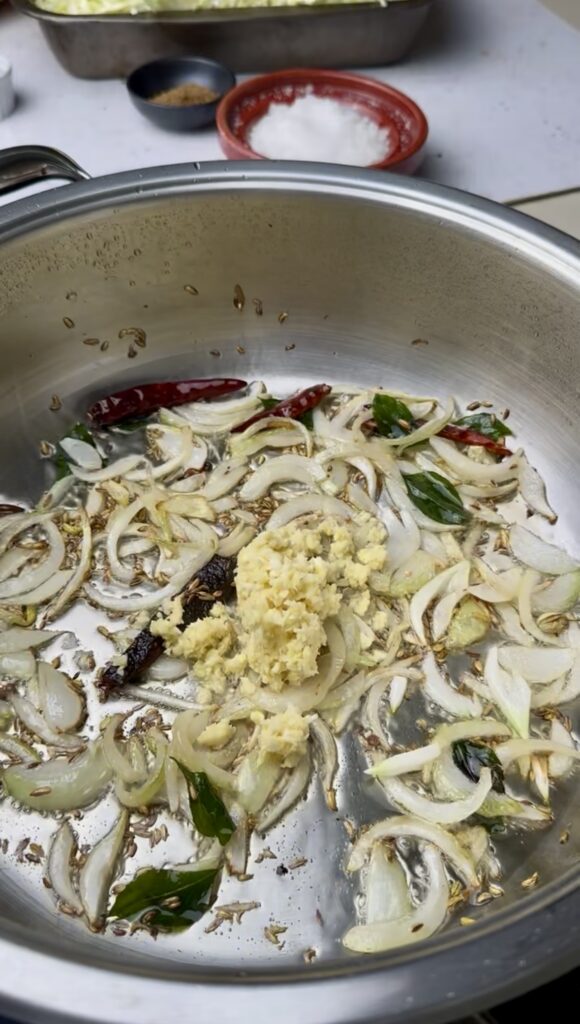
Step 4: Add the Durban Curry Powder
Add the Durban curry powder and mix it through the onions.
Watch the heat carefully so the spices do not burn.
If the masala begins catching, add a small splash of water.
Step 5: Add the Tomatoes
Add the crushed tomatoes and mix well until the onions, tomatoes and spices are fully incorporated.
Season with coarse salt and cook for about 4 minutes.
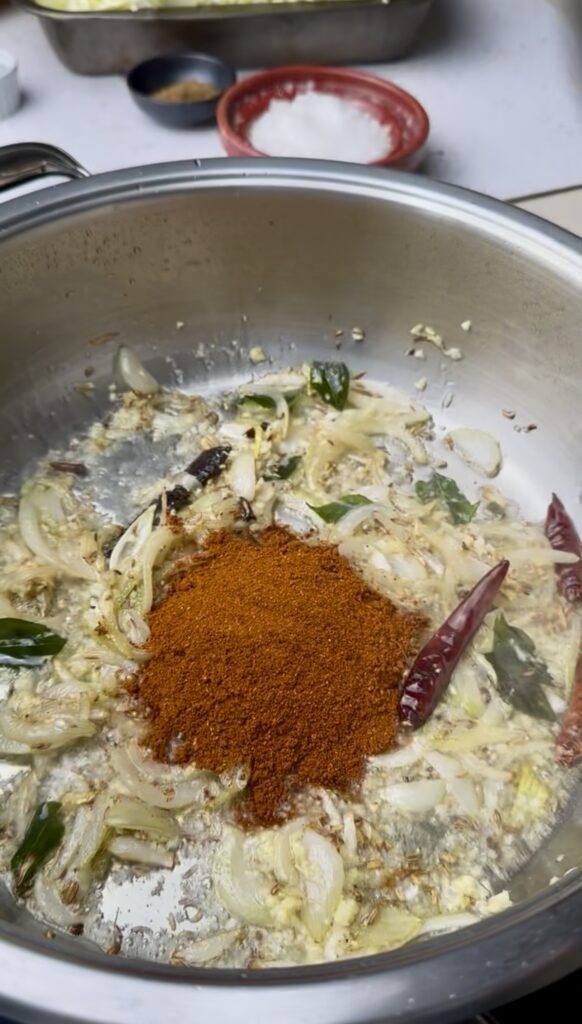
Step 6: Add the Lamb
Add the lamb pieces and toss well so all the meat is coated in the tomato masala.
Cover and cook over medium heat for about 30 to 35 minutes.
Do not add water unless needed. The lamb will release its own juices.

Step 7: Add the Ground Spices
Add the jeera powder and dhania powder and mix well.
Step 8: Add the Cabbage
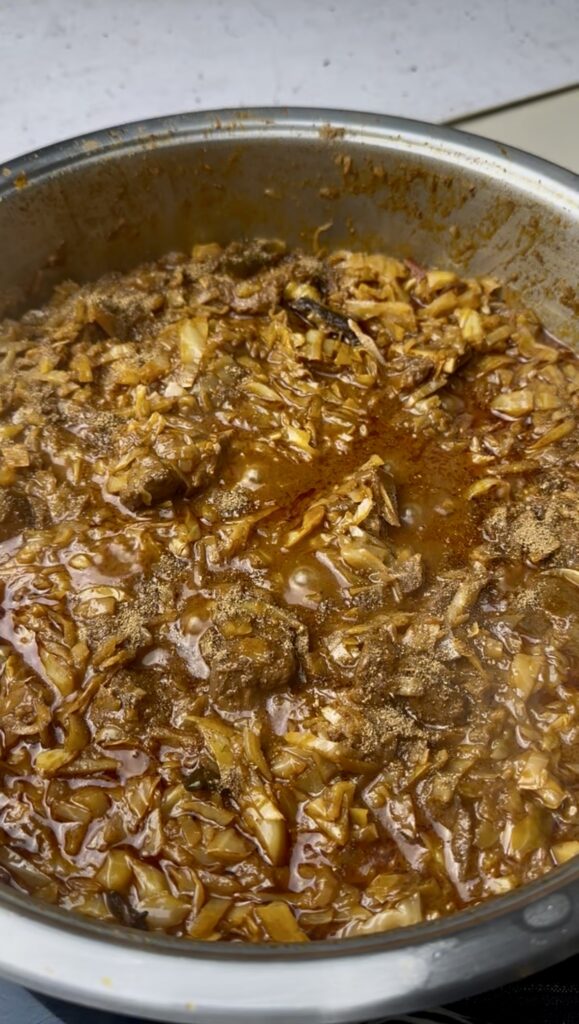
Add the sliced cabbage and give everything a good toss so the cabbage is coated in the masala and mixed through the lamb.

Step 9: Cook Gently
Cover and cook over medium to lower heat for another 45 minutes to 1 hour.
Check occasionally and stir gently.
Cook until the lamb is tender and the cabbage has softened beautifully.
Step 10: Finish the Curry
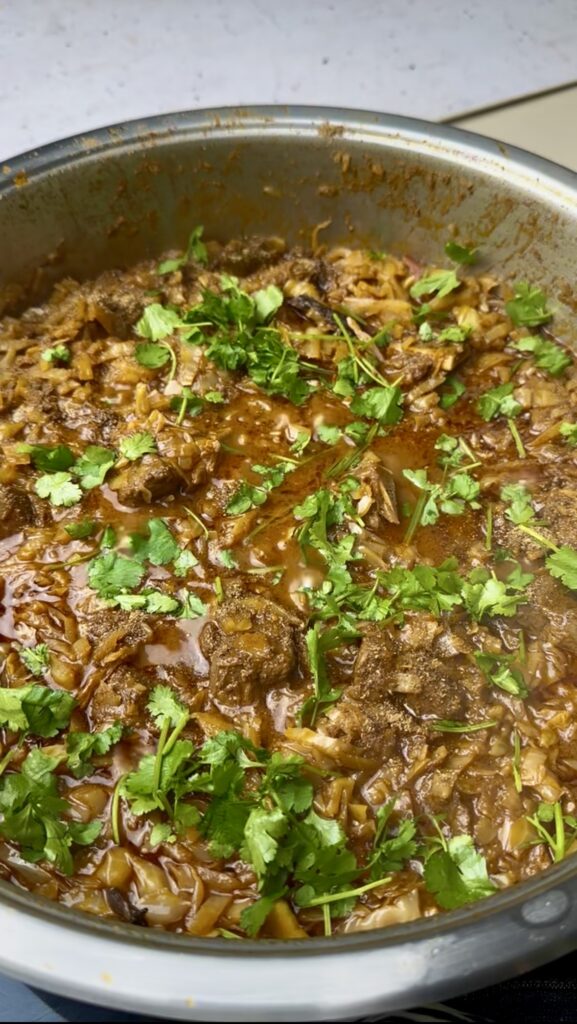
Sprinkle over the garam masala and garnish generously with chopped dhania.
Serve hot.

How Do You Know When Mutton and Cabbage Curry Is Ready?
Do not judge this curry purely by the clock.
The lamb should be tender and the cabbage should be soft and well incorporated into the masala.
You should not have a pot of watery cabbage with pieces of meat sitting in it. Everything should feel as though it has cooked together.
The cabbage will have reduced considerably and taken on the colour and flavour of the curry.
Once everything is tender, sprinkle over the garam masala and finish with freshly chopped dhania.
That final addition of garam masala gives the curry another layer of warmth without needing to cook it for a long time.
A Note About Cooking Times in Johannesburg
Cooking times can vary and where you live can actually make a difference.
Johannesburg sits at a high altitude. Because water boils at a lower temperature at higher elevations, foods cooked by simmering can sometimes take longer to become tender than they would at sea level.
So treat the cooking times in this recipe as a guide rather than an absolute rule.
Your particular cut of lamb also matters. One batch may soften sooner than another.
If your lamb still needs time after the suggested cooking period, simply continue cooking it gently until tender.
Check the moisture level as you go and add a little water only when necessary.
If you are making this curry in Durban at sea level, you may find that your meat cooks a little sooner.
How Much Durban Curry Powder Should You Use?
I use around 5 tablespoons of Durban curry powder in this recipe because there is 1 kilogram of lamb and a generous 800 grams of cabbage in the pot.
But curry powders and masalas vary enormously.
Some are much hotter than others and everyone’s tolerance for chilli is different.
If your particular blend is very hot or you prefer a milder curry, use less.
If your masala is relatively mild and you like your curry with a proper kick, use the full amount or adjust it to suit your taste.
The recipe should still taste like your food when it reaches your table.
Fresh Tomatoes or Crushed Tomatoes?
Both work.
If using fresh tomatoes, add around 2 to 3 tomatoes, depending on their size.
For this particular curry, however, I personally prefer crushed tomatoes. I find they cook into the spices beautifully and give me the consistency I want in the finished gravy.
That is not a rule. It is simply one of those little personal cooking preferences you develop after making curries over the years.
Tips for the Best Mutton and Cabbage Curry
- Give the onions time to soften and caramelise. They form an important part of the masala base.
- Lower the heat before adding the ground spices. Durban curry powder can burn quickly and burnt masala can make the entire curry bitter.
- Do not drown the lamb in water. Give the meat time to release its own juices first.
- Give the meat a head start. Partially cooking the lamb before adding the cabbage helps both ingredients reach the right texture.
- Do not panic when you see all that cabbage. It reduces dramatically as it cooks.
- Use a heavy-based pot if possible. This is a relatively long-cooking curry and a good pot helps distribute the heat more evenly.
- If using breast or rib meat, reduce the oil. These cuts contain more fat and will render plenty of richness into the curry as they cook.
- Taste as you go. Curry powder, salt levels and cooking times should always be adjusted to suit your ingredients.
What to Serve with Mutton and Cabbage Curry
This is proper comfort food and it does not need complicated sides.
I love it with fresh roti because you can scoop up the soft cabbage, tender lamb and masala together.
Rice is equally good and homemade naan works beautifully too.
You could also serve it with a little pickle or achar on the side if you want something sharp and spicy against the richness of the lamb.

Frequently Asked Questions
Can I use lamb instead of mutton for mutton and cabbage curry?
Absolutely. I actually use lamb leg cut into curry pieces for this recipe. In many South African Indian homes, particularly in Durban, the term mutton is commonly used when talking about dishes made with sheep meat, including lamb.
What meat was traditionally used for mutton and cabbage in Durban?
Breast meat and rib pieces were commonly used in many Durban Indian homes. These fattier cuts work particularly well with cabbage because the rendered fat adds richness and flavour to the vegetables.
Should I use less oil if I use breast meat or ribs?
Yes. Breast and rib meat contain more fat than lamb leg, so begin with less oil and allow the meat to render its own fat as it cooks.
Do I need to add water when cooking the lamb?
Not necessarily. The lamb releases its own juices as it cooks. I prefer allowing that moisture to form naturally before adding water. If the curry begins catching at the bottom of the pot, add a little water as needed.
Does cabbage release water when cooked in curry?
Yes. Cabbage contains plenty of moisture and releases some of it as it cooks. This is another reason not to add too much water to the pot.
Can I use fresh tomatoes instead of crushed tomatoes?
Yes. Use approximately 2 to 3 fresh tomatoes depending on their size. I personally prefer crushed tomatoes in this recipe because I like the consistency they give the finished gravy.
Can I make this curry less spicy?
Yes. Adjust the amount of Durban curry powder according to the heat of your particular masala and your personal preference.
Why is my lamb taking longer to become tender?
The cut of meat can affect cooking time. Altitude can also make simmered dishes take longer to cook. In Johannesburg, you may sometimes need a little more time than someone cooking the same dish at sea level.
Can I make mutton and cabbage curry ahead of time?
Yes. This is a lovely curry to make ahead because the flavours have time to settle. Reheat it gently and add only a small splash of water if it needs moisture.
Final Thoughts
Mutton and cabbage curry is not a fancy dish and I think that is exactly what makes it so special.
It is one of those proper home-cooked Durban Indian curries where humble cabbage goes into a pot with meat and somehow comes out tasting like it was always meant to be there.
The cabbage softens, the lamb becomes tender and everything cooks together in that rich Durban masala until you can barely separate where one flavour ends and the next begins.
For those of us who grew up knowing dishes like this, there is comfort in simply seeing a pot of cabbage and mutton on the stove.
It connects us to kitchens where recipes were rarely measured, where meat and vegetables were cooked together to feed families and where a pot of curry was as much about home as it was about dinner.
My version may use lamb leg instead of the breast meat and ribs I remember, but the heart of the dish has not changed.
It is still mutton and cabbage.
And that is exactly how I want to remember it.
Other recipe to try. Click on the image for the recipe. Don’t forget to follow me on my socials so you don’t miss a thing.
https://www.instagram.com/apriena

The Best Mutton and Cabbage Curry – A Durban Indian favourite
This mutton and cabbage curry is a traditional-style Durban Indian dish made with tender lamb, cabbage, Durban curry powder, tomatoes and warming spices. The lamb cooks in its own juices before the cabbage is added so the vegetables absorb all that rich masala flavour.
Ingredients
Instructions
-
Heat the oil in a large heavy-based pot over medium heat.
-
Add the biryani mix and dried red chillies and fry for about 1 minute until fragrant.
-
Add the sliced onion and allow it to soften and begin caramelising.
-
Lower the heat slightly and add the ginger and garlic paste. Fry for about 1 minute.
-
Add the Durban curry powder and mix well. Take care not to burn the spices. Add a small splash of water only if the masala begins catching.
-
Add the crushed tomatoes and mix well.
-
Season with coarse salt and cook the tomato masala for about 4 minutes.
-
Add the lamb pieces and mix well so the meat is coated in the tomato masala.
-
Cover and cook over medium heat for about 30 to 35 minutes. Do not add water unless needed, as the lamb will release its own juices.
-
Add the jeera powder and dhania powder and mix well.
-
Add the sliced cabbage and toss well with the lamb and masala.
-
Cover and cook over medium to lower heat for another 45 minutes to 1 hour, or until the lamb is tender and the cabbage is soft.
-
Check occasionally and add a little water only if needed.
-
Sprinkle over the garam masala.
-
Garnish with chopped dhania and serve hot with roti, rice or naan.
Note
This dish is traditionally known as mutton and cabbage in many Durban Indian homes even when lamb is used.
Breast and rib meat can be used for a more traditional version.If using breast or rib meat, reduce the oil because these cuts render more fat.
Lamb leg is leaner and is my preferred cut.
Do not automatically add water.
The lamb and cabbage release their own moisture as they cook.
Fresh tomatoes can replace the crushed tomatoes. Use about 2 to 3 depending on size.A
djust the Durban curry powder according to your preferred heat level.
Cooking times may vary depending on the cut of meat and altitude.


